
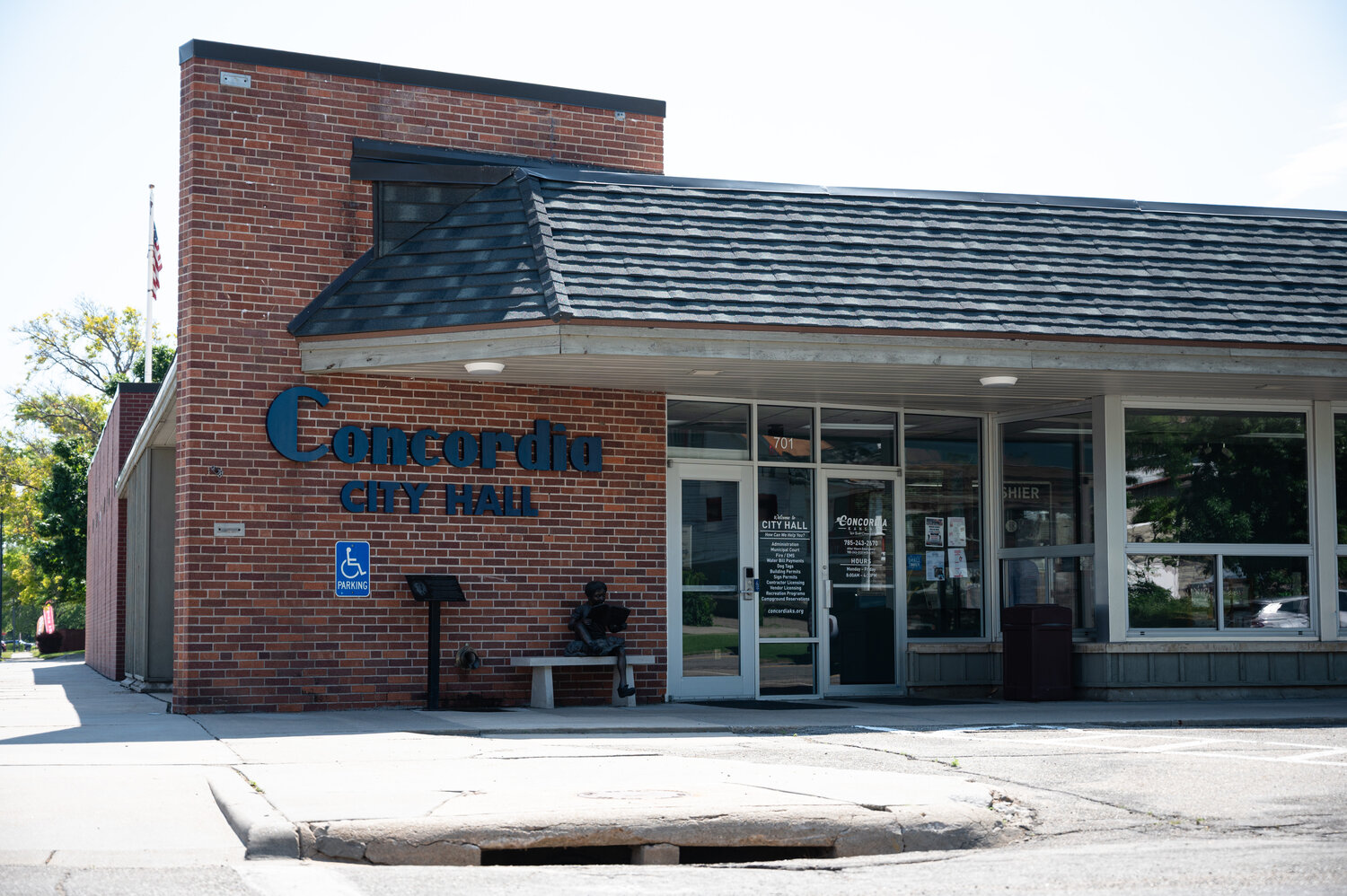
An ordinance limiting access of electric scooters (E-scooters), electric bicycles (E-bikes) and electric tricycles (E-trikes), and a wage study presentation by the Concordia Police Department were part of the regular meeting of the city commission on Wednesday, July 1. Commissioner Marsha Wentz attended the meeting via Zoom.
The meeting began with a presentation by the National Society Daughters of the American Revolution (DAR) commemorating the nation's 250th birthday.
A public hearing was then held for the structure at 424 East 1st Street. A representative of the owner spoke and asked commissioners for time to work on the structure, since the owner is unable to perform the work because of age and residency.
The public hearing was closed.
A public hearing was then held for the condemnation of the structure at 321 East 12th Street. There were no public comments, and the meeting was closed.
Commissioners then approved Resolution 2026-2236 that condemned the structure at 321 East 12th.
Commissioners next approved Resolution 2026-2237 that condemned the structure at 424 East 1st but with an extended time allowance for the representative of the owner to work with the City to repair or remove the structure.
Next on the action item portion of the agenda, commissioners approved the bid from Wilson Security Solutions LLC to replace the fire alarm panel, with a 10% contingency, in the amount of $5,472.50, to paid from the General Fund Reserve.
Fire Chief John Christensen reported to commissioners that the City Hall fire alarm panel needed to be replaced due to a “trouble light” that could not be fixed. Two companies, Johnson Controls and Wilson Security, tried to repair the problem but could not find a solution. Both companies reported that the panel was aged to the point that it would be very difficult to get parts. Both companies recommended replacing it.
Wilson Security Solutions LLC was the only company that submitted a bid.
Commissioners then approved a new billing contract with Thea McMillan to do the City's ambulance billing. McMillan has done the billing for 12 years.
Commissioners passed amended Ordinance 2026-3245 that regulates the operation of E-scooters, E-bikes, and E-trikes within City limits.
Police Chief Brent Gering reported that due to the significant growth of these modes of transportation, especially among children, and the increase in hospital and emergency room visits because of accidents, it was necessary to limit their access in high traffic areas within City limits. Gering specifically pointed out the inability of car and truck drivers and pedestrians to see the E-scooters, most of which are operated by children.
Among the new regulations:
'Operation of electric bicycles or tricycles / electric scooters upon sidewalks shall be permitted only in parks, residential areas, and along state and federal highways, except as otherwise stated in this ordinance.'
'Operation of electric bicycles or tricycles / electric scooters is prohibited within pedestrian-dense areas, including: Upon sidewalks within Broadway Plaza, within the Concordia Sports Complex during events and when school is in session, Within the Downtown Business District, operation upon sidewalks shall only be permitted when: the operator rides on the portion of the sidewalk nearest the curb, and the electric bicycle or tricycle / electric scooter is operated at a speed not exceeding seven (7) miles per hour, and the operator must yield the right-of-way to all pedestrians at all times.'
'Operators must dismount the electric bicycle or tricycle / electric scooter and walk them through these areas.'
Helmet: 'Any operator under eighteen (18) years of age shall wear a properly fitted and fastened protective helmet meeting applicable safety standards.'
Lighting: 'Any electric bicycle or tricycle/ electric scooter operated between sunset and sunrise shall be equipped with: A white light visible from the front; and A red light or reflector visible from the rear.'
Brakes. 'Every electric bicycle or tricycle/ electric scooter shall be equipped with a functional braking system capable of stopping the device under normal operating conditions.'
To view the entire Ordinance 2026-3245 and all its regulations, visit the City's website concordiaks.org.
In their final action of the evening, commissioners approved a professional services agreement with Campbell & Johnson Engineers P.A. for new public infrastructure at the Concordia Industrial Park, in the amount of $98,500, to be paid from the Water Fund, Wastewater Fund, and City Reserves, with incremental reimbursement expected as lots are sold.
City Manager Amy Lange reported to commissioners that the Concordia Industrial Park has been dormant for over thirty years, with the most recent development completed in the early 1990s. The impediment to development, at least in recent years, has been the significant economic barrier of infrastructure construction.
Lange reported that to enable future development, particularly for small businesses, it would be necessary to make infrastructure costs more budget-friendly on a per-lot basis.
Recent discussions with potential industrial development spurred conversations about the need to construct public infrastructure to serve these developments, including a new street, storm sewer improvements, and water and sanitary sewer main extension. Extension of private utilities such as electric, telecommunications, and natural gas will also be necessary.
During the June 17, 2026, city commission meeting, commissioners approved a development agreement with Sunflower Electric to establish a new facility on Lots 12, 13 and 14 in the Concordia Industrial Park, thereby solidifying the need and commitment to construct the infrastructure necessary to serve this and future industrial development in the area. Work on both projects is expected to be complete by the end of 2026.
The professional services agreement with Campbell & Johnson describes the scope of work to
be provided related to design, construction administration, and construction observation for the public infrastructure to serve the Concordia Industrial Park, with an associated cost of $98,500.
The City is requiring this infrastructure to be designed and constructed to public standards, and therefore will take the lead on this infrastructure project. In an effort to keep overall project costs down, the City and County have agreed to construct the street, storm sewer improvements, and water main extension with force account labor. The sanitary sewer main extension will need to be contracted out due to the depth of the line and the equipment required to perform this work. The street is intended to be gravel, similar to recent extensions of Ft. Kearney Street and E. 19th Street to serve industrial development in those areas of town.
This expense was unplanned within the Capital Improvement Plan (CIP) at the time the FY 2026 budget was prepared. Therefore, this project will need to be funded from a combination of the Water Fund, Wastewater Fund, and City Reserves. Sunflower Electric has agreed to pay a pro-rated portion of the cost of this infrastructure. The remainder of the cost is expected to be incrementally reimbursed to the City from the future sale of the remainder of the lots served by these improvements.
With no further items on the agenda, the meeting adjourned at 6:32 p.m
The commission then convened a study session regarding pay for the police department. Police Chief Gering, Lieutenant Adam Sorell, and Detective Emma Thyfault made the presentation to commissioners. Lt. Sorell stated that while beginning pay for Concordia police officers is comparable with the police departments in surrounding communities, there was a large gap between what is paid to officers with three or more years of experience. In some instances, Concordia officers with three-to-five years of experience are being paid up to 26% less than officers in comparable communities. This wage gap applies to all ranks, all the way up to the Chief of Police's salary.
Lt. Sorell and Chief Gering stated that this wage gap makes it difficult to retain veteran officers who can earn $8,000 to $12,000 more a year in a different community.
Among the communities that Chief Gering, Lt. Sorell, and Det. Thyfault used for comparison were Belleville, Beloit, Wamego, Marysville, Clearwater, Abilene, and Salina because of its short driving distance for a locally-based officer, and even towns with a community college like Colby and Pratt.
The study session ended at 7:03 p.m.
Commissioners then convened a meeting of the Land Bank and approved the transfer of the deed to the property located at Lot 6, Block B of the St. Joseph Subdivision.


